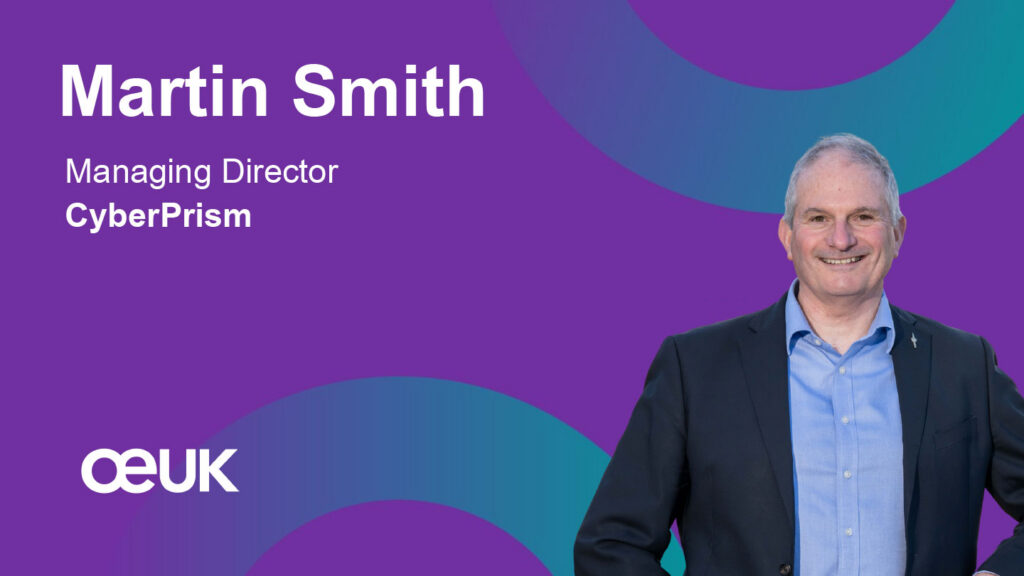
Martin Smith is Managing Director of CyberPrism, a cybersecurity company specialising in the protection of operational technology across critical national infrastructure, with a particular focus on the energy sector. A former Royal Marines officer who served for 33 years, including as Commandant General of the Royal Marines, he now leads a team helping energy companies strengthen cyber resilience and safeguard critical assets.
“Being the managing director of a technology company is engaging, rewarding and demands constant attention – a challenge not entirely dissimilar to much of what I encountered during my time in the Royal Marines. In many ways, we are doing the same things – leading, managing and growing organisations.
The physical threat levels are lower in business, but security is a common theme.”
I’m 63 and am currently the Managing Director of Cyber Prism Limited, a cybersecurity company which specialises in protecting industrial control systems across Critical National Infrastructure, with a particular focus on the energy industry.
I was born and brought up in Kent. Growing up in a rural environment, I developed a particular love of the sea, which naturally shaped my interests in outdoor pursuits such as camping, kayaking and swimming. This also manifested in my education, cultivating a deep interest in science, particularly biology; I later went on to study Zoology at Bristol University.
After university, I joined the Royal Marines, where I spent 33 years serving our country. These three decades allowed me to be involved in some incredible activities, from live operations around the world to training in the harshest environments: the Arctic, jungle, desert and, of course, our hardest taskmaster – the sea. That said, the best thing about life in the Royal Marines was the opportunity to work with fantastic people every day as we took on a range of challenges open only to those in the Armed Forces. Information increasingly lay at the heart of what we did, with the realisation that the conflicts of the future would be won and lost in cyberspace as much as in the physical domain: that reality is very much with us now. I was lucky enough to be promoted to Major General after 30 years at the age of 51, becoming the Commandant General of the Royal Marines, leading Britain’s 7,000 Commandos: a huge privilege, and a position in which I was able to maintain a focus on information warfare – a crucial factor in shaping our Defence capability.
I suppose the transition was not as unexpected as it might seem. After spending much of my later career focused on information warfare, moving into cybersecurity felt like a natural next step. Equally, I had long been drawn to the oil and gas industry, an interest that can probably be traced back to my father – he was an engineer and his first job was with Shell in Trinidad. It combines such a range of disciplines and operates on the edge, in harsh environments, under constant operational and financial pressures. Very exciting.
Now, in my current role, being the managing director of a technology company is engaging, rewarding and demands constant attention – a challenge not entirely dissimilar to much of what I encountered during my time in the Royal Marines. In many ways, we are doing the same things – leading, managing and growing organisations. The physical threat levels are lower in business, but security is a common theme. Our company combines deep technical expertise with an instinctive feel for security, born in part of the time that many of our people have spent in the Armed Forces, so I feel very much at home. In the end, it’s about generating trust and mutual respect – both inside the company and with our external stakeholders.
What makes the sector particularly exciting today is the scale of change underway. As the UK diversifies its energy mix and works towards a lower-carbon future, companies are being asked to deliver more than ever before – safely, securely and efficiently. We are as much an engineering company as a cyber security company, which gives us a unique perspective on how digital technologies can not only strengthen security but also optimise operations, enable better use of data and help support the industry’s transition to a more integrated energy system.
What gives me confidence in the UK’s energy future is that, despite the challenges ahead, the industry starts from a position of enormous strength. We have a fantastic reservoir of talent, intellect and skill across the UK energy sector. The key will be setting clear strategies and creating the certainty companies need to invest and innovate. If we can move forward with a degree of unity and shared purpose, there is no obstacle we cannot overcome.
Over the past eight years at CyberPrism, I’ve had the privilege of working across a diverse range of projects within the UK’s energy sector. While much of that work remains behind the scenes, I’m proud of the contribution we have made to the protection of infrastructure which is critical to the security of the UK and our partners, as threat levels continue to rise. It is really satisfying to move from a one-off project with a new client to a trusted, enduring relationship with that organisation.
To those looking to join the industry or finding themselves gravitating towards it as I once did – trust is essential. Work hard to earn that trust and success will follow. This is a fantastic industry with tremendous opportunities for those who are capable and trusted.
Find out more about CyberPrism here
Share this article