

There’s been a lot of commentary recently questioning whether the North Sea still matters to the UK.
We’ve seen claims that new licences deliver “only days of gas”, that producing energy here makes no difference because prices are set globally, and that the UK is more or less out of resources anyway.
These arguments sound simple. But they don’t reflect how the UK energy system actually works, or what the evidence shows.
And that matters, because these debates shape decisions that affect households, jobs, and how secure our energy supply really is.
So let’s take a step back and look at the facts.
Claim: Hundreds of North Sea licences have delivered only “36 days of gas”, proving new drilling does not improve energy security.
The reality:
This actually proves the opposite. In a mature basin like the North Sea, you need a constant churn of investment and new licences just to stand still. Without ongoing activity, decline accelerates and import dependence rises faster. That is why countries like Norway continue to license and develop new projects. Their approach allows them to replace what they produce and manage decline more effectively. In industry terms, this is measured through the reserves replacement ratio – how much new resource is added compared with what is produced. Norway consistently produces a higher reserves replacement ratio than the UK. Over the 5 year period 2019-2024, through exploration, Norway replaced on average 46% of the reserves that were produced, the UK however, replaced just 14%.
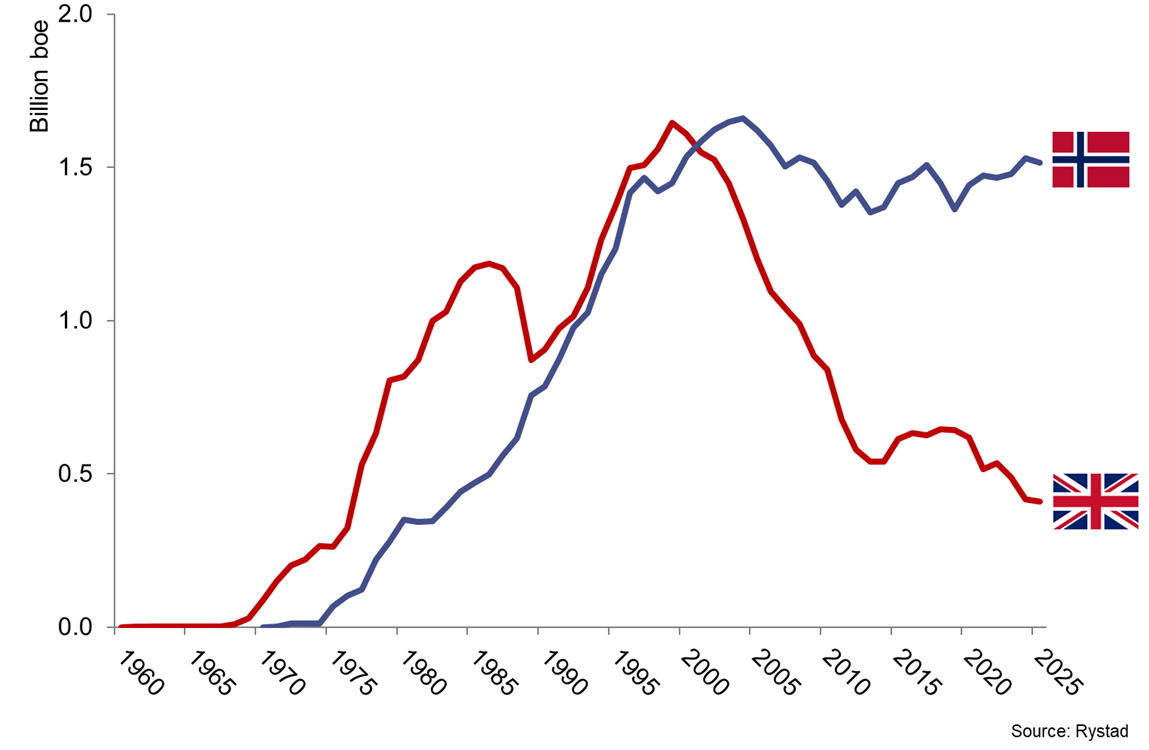
Granting licenses does not deliver instant volumes. They exist to sustain future supply and slow decline over time. Modern UK projects do not take decades to come online – long timelines often quoted reflect historic projects that were paused and later revived, not today’s basin.
Today, the North Sea still provides over half of the UK’s oil and gas needs. With the right conditions, we can sustain production for longer, reduce exposure to imports, and manage the transition more securely. Without licensing and investment, the UK simply becomes reliant on overseas supplies sooner – regardless of demand falling.
Claim: Domestic production doesn’t matter because prices are global
The reality:
It’s true that UK gas prices are influenced by international markets. But that doesn’t mean domestic supply is irrelevant.
What recent energy crises showed very clearly is this: the more energy you import, the more exposed you are.
Imported gas, especially liquefied natural gas (LNG), is bought on a global market. When there’s disruption anywhere in the world, prices rise quickly. Cargoes are diverted, shipping costs increase, and countries compete for supply.
Domestic production helps protect against that. It provides steady supply into the UK system, reduces how much LNG we need to buy, and keeps key infrastructure working.
Even in a global market, countries that rely less on imports are less vulnerable. That’s exactly what domestic production does.
Claim: 93% of UK North Sea oil and gas has already been extracted, so new drilling makes little difference.
The reality:
The UK Continental Shelf has already produced a huge amount of energy over the last 50 years. That much is not in dispute.
What’s often left out is what remains.
Official projections show several billion barrels of oil and gas still expected to be produced between now and 2050. Independent analysis commissioned by OEUK shows that, with the right conditions, significantly more could be delivered from known projects and discoveries.
And even beyond that, the UK’s own regulator identifies large volumes of oil and gas in:
- approved projects
- existing discoveries
- areas that haven’t yet been developed
This isn’t speculation. These are recognised resources.
The real question isn’t whether the UK will keep using oil and gas for a while longer. All credible pathways say we will. The question is where that supply comes from.
A balanced approach
The UK’s energy transition requires:
- accelerating renewable energy,
- improving energy efficiency,
- reducing demand,
- and maintaining domestic supply while it is still needed.
Presenting this as a choice between clean energy and UK production is a false choice.
For transparent, up‑to‑date data on UK energy demand, production, imports and emissions, visit OEUK’s Key Facts page:
👉 https://oeuk.org.uk/who-we-are/key-facts/
If you see coverage or commentary that misrepresents the facts, you can contact OEUK’s rapid rebuttal team at:
Share this article